
Cannabis retail is at a breaking point.
The industry is more than a decade into patchwork state legalization. Competition is intensifying, margins are thinner, and operators are expected to deliver modern, Amazon-level customer experiences inside one of the most complex regulatory environments in America.
But the technology behind the counter isn’t keeping up.
Flowhub Founder and CEO Kyle Sherman sat down with Alpine IQ (AIQ) Founder and CEO Nicholas Paschal during MJBizCon 2025 to discuss the current state of cannabis technology.
Watch the exclusive founder-to-founder conversation or read on for the key takeaways.
The current state of cannabis tech
Legal cannabis is scaling fast, and retail technology has to grow up with it.
Cannabis retail is complex, operationally demanding, and compliance-driven. Today’s top performing dispensaries require a full tech stack to compete, spanning point of sale (POS), online ordering (ecommerce), delivery, payment processing, HR/payroll, loyalty/marketing platforms, BI tools, and more.
Cannabis retailers’ ability to stay competitive in their respective markets is largely determined by their technology infrastructure. A strong brand matters, but retailers must also implement strong core operating systems to power growth.
Read next
What is a Dispensary Growth Platform?
In recent years, we've experienced an arms race toward the "all-in-one" cannabis technology solution promise. On paper, it’s attractive: one platform, one vendor for everything.
In practice, closed “all-in-one” platforms create long-term opportunity costs — watered-down functionality, vendor lock-in, and customer records that are difficult to export. These walled systems don’t just slow teams down, they introduce structural risk as a single point of failure.
People just want tech to work in this space. They want all the systems to connect and communicate seamlessly where they don’t have to guess if it’s right or accurate when a customer comes in and has their experience.
Kyle Sherman, Founder and CEO of Flowhub
Retailers don't need less software. They need less friction: systems that connect, data that’s trustworthy, and the freedom to evolve their stack and scale responsibly as the market changes.
That’s why open API ecosystems are becoming the foundation of how serious cannabis retailers build for the long term.
This shared belief is what brings Flowhub and AIQ together.
Why “all-in-one” platforms are failing
Closed "all-in-one" platforms sell certainty. In reality, they deliver fragility.
If cannabis retailers wish to continue attracting mainstream consumers (and investors), their standard operating procedures should mirror those used in established sectors. Currently, more than half the world’s websites run on open architecture software.
The most durable software categories aren’t won by companies that try to build everything. In modern software, the biggest platforms win by enabling ecosystems, not blocking them:
-
Salesforce’s AppExchange powers 7M+ installs across its open ecosystem
-
Shopify merchants using app integrations grow revenue 30–40% faster than those who don’t
-
Apple’s App Store generates $1T+ in developer commerce, precisely because Apple didn’t try to build everything itself
For me, watching these companies go the opposite way and try to close off their ecosystems and not allow third-party partners—and be abrasive about it—is just the wrong path. It’s never worked outside of cannabis. It’s never worked in any other industry.
Nick Paschal, Founder and CEO of AIQ
In cannabis, some vendors are choosing to lock APIs, restrict data exports, and white-labeling tools they didn’t build. That strategy isn't about innovation or supporting the customer. It's about squeezing more wallet share from operators and monopolizing the market.
Read next
How to Avoid Predatory Cannabis Contracts
Closed ecosystems optimize for vendor control. Open ecosystems optimize for retailer outcomes — flexibility, innovation, and the ability to evolve your stack without rebuilding your business every two years.
When vendors try to own the entire stack, they stop building for customers and start building for themselves.
Kyle Sherman, Founder and CEO of Flowhub
What’s the difference?
🔗 Open ecosystem: A platform that freely supports and encourages integrations with other technology and services.
🚫 Closed system: A platform that only interacts with tools that are inside or compatible with that platform. Essentially, it’s a single vendor solution from end-to-end.
The real danger: your customer data gets trapped
Retailers operating on closed ecosystems risk losing control of the most valuable asset they own: their customers.
When customer data is held hostage:
- loyalty programs become less portable
- marketing ROI becomes harder to measure
- switching vendors becomes painful and expensive
- the operator loses negotiating power
It's really unstable. If they’re a closed off ecosystem, you can’t even download a list of your own customers that you paid for to drive through your front door at will.
Nick Paschal, Founder and CEO of AIQ
What retailers should demand from their tech stack (a quick checklist)
If you’re evaluating new cannabis technology, here are the non-negotiables that separate scalable stacks from future rebuilds:
- Real-time access to data
- Open APIs
- Easy export of customer + transaction data
- No long term hostage tactics (you should be able to leave)
- Best-in-class integrations
- Cannabis compliant workflows
- Support that scales
If a vendor can’t clearly answer these, you're putting your business at risk.
What the connected future actually looks like
Open API ecosystems unlock immediate advantages — not because they invent new workflows, but because they make them real-time, reliable, and flexible across best-in-class platforms.
With a connected cannabis stack:
Retailers have complete ownership and control over data and the customer experience
Inventory, compliance, and engagement tools share a single source of truth
Operators move faster with fewer manual steps, fewer errors, and less risk
Customer data and segmentation update in real time, not overnight
Marketing triggers fire based on live transactions, not static lists
Examples:
- A customer completes an order through Flowhub → AIQ automatically triggers a “thank you + review request” message
- A customer is eligible for a loyalty offer → the POS reflects it instantly at checkout
- A loyalty member abandons their cart → a compliant reminder is sent within minutes while intent is still high
- A dispensary can run a custom SEO-optimized ecommerce storefront through Rank Really High fully integrated with POS + marketing systems
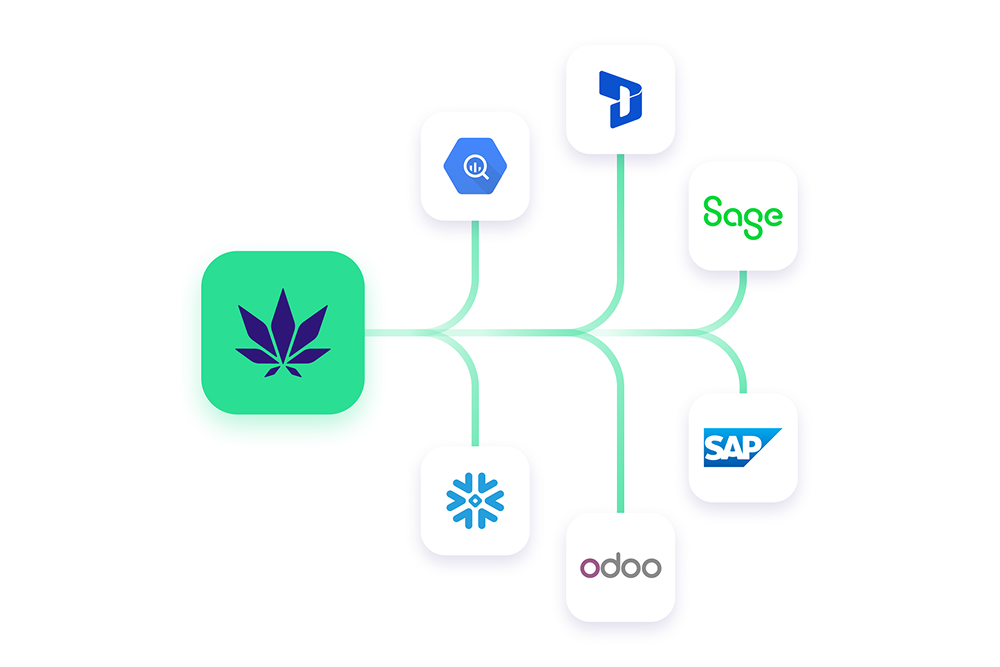
- All data can flow seamlessly to ERP systems like Microsoft Dynamics, Sage, Odoo, and SAP or BI tools and data warehouses like Snowflake and Google BigQuery
The future of cannabis retail is real‑time. If your systems lag, your customer experience does too.
Kyle Sherman, Founder and CEO of Flowhub
This is the foundation of the Flowhub + AIQ integration.
Flowhub anchors the transaction with compliant POS, inventory, and data infrastructure. AIQ activates the customer with real‑time loyalty and compliant engagement across marketing channels.
Open ecosystems allow retailers to combine best-in-class tools instead of being forced into a single bundled solution.
Why this matters right now
The industry has changed.
Growth‑at‑all‑costs models are failing
Unprofitable companies are disappearing
Operators are demanding sustainable ROI, not roadmaps from tech providers
At the same time, demand continues to expand:
New cannabis markets are coming online
Younger consumers are choosing cannabis over alcohol
Legal operators are positioned to reclaim share from illicit markets
Forward-thinking dispensaries who win the next retail boom will make sure that their tech stacks directly cater to their long-term growth goals. There’s no one-size-fits-all solution in a space this nuanced and regulated. Retailers that accept this sooner rather than later and utilize customized tech stacks will have the tools they need to overcome future industry headwinds.
Flowhub and AIQ are both founder‑led, profitable, and reinvesting for the long term. That alignment allows us to build flexible integrations on scalable infrastructure.
That's why we're committed to open API ecosystems as the future of cannabis retail tech. They’re the minimum requirement for scaling in a maturing industry.
They reduce risk, accelerate innovation, and give operators back control over their own businesses.
You can make the entire industry better by building good products, treating customers fairly, and letting systems work together.
Kyle Sherman, Founder and CEO of Flowhub
That’s the future Flowhub and AIQ are building, and the operators who adopt it now won’t have to rebuild later.
Click here to claim our exclusive Flowhub x AIQ partner discount, valued up to $10k annually.


