
The cannabis retail landscape has officially transitioned from the stockpiling era into the efficiency era. As markets mature and competitive pressures mount, the narrative has shifted from raw foot traffic to transactional quality.
In 2026, the industry is seeing a sophisticated pivot: while total consumer demand remains resilient, shopping habits have evolved toward budget optimization. Customers are visiting more frequently but with more surgical intent, leading to a rise in micro-transactions and a premium on digital convenience.
Below is an expanded analysis of the state of cannabis retail, drawn from Flowhub transaction data from 2025, alongside broader industry shifts to illustrate what’s happening now and how to prepare for the future.
| Metric | 2026 Data Point | Industry Context |
|---|---|---|
| Online AOV | $68.01 | 35% higher than walk-in ($50.56) |
| Online Cart Size | 3.9 items | 44% larger than physical baskets |
| In-store Average Cart | 2.7 items | 7% decline YoY from 2.9 |
| Cash Payments Share | 59% | Falling as digital payments rise |
| Digital AOV (ACH/Apps) | $93.50 | 90% higher than cash ($49.25) |
| Female AOV | $54.37 | Higher than male spend ($53.29) |
| Boomers & Silent Gen AOV | $62+ | Largest carts at 3.2-3.3 items |
| Flower Category Share | 44% | Stable revenue cornerstone |
Online ordering as a revenue engine
While walk-in dispensary shoppers still make up the lion's share of sales volume—accounting for anywhere from 75-90% of all transactions—the digital-first shopper has become the most profitable segment for the modern dispensary.
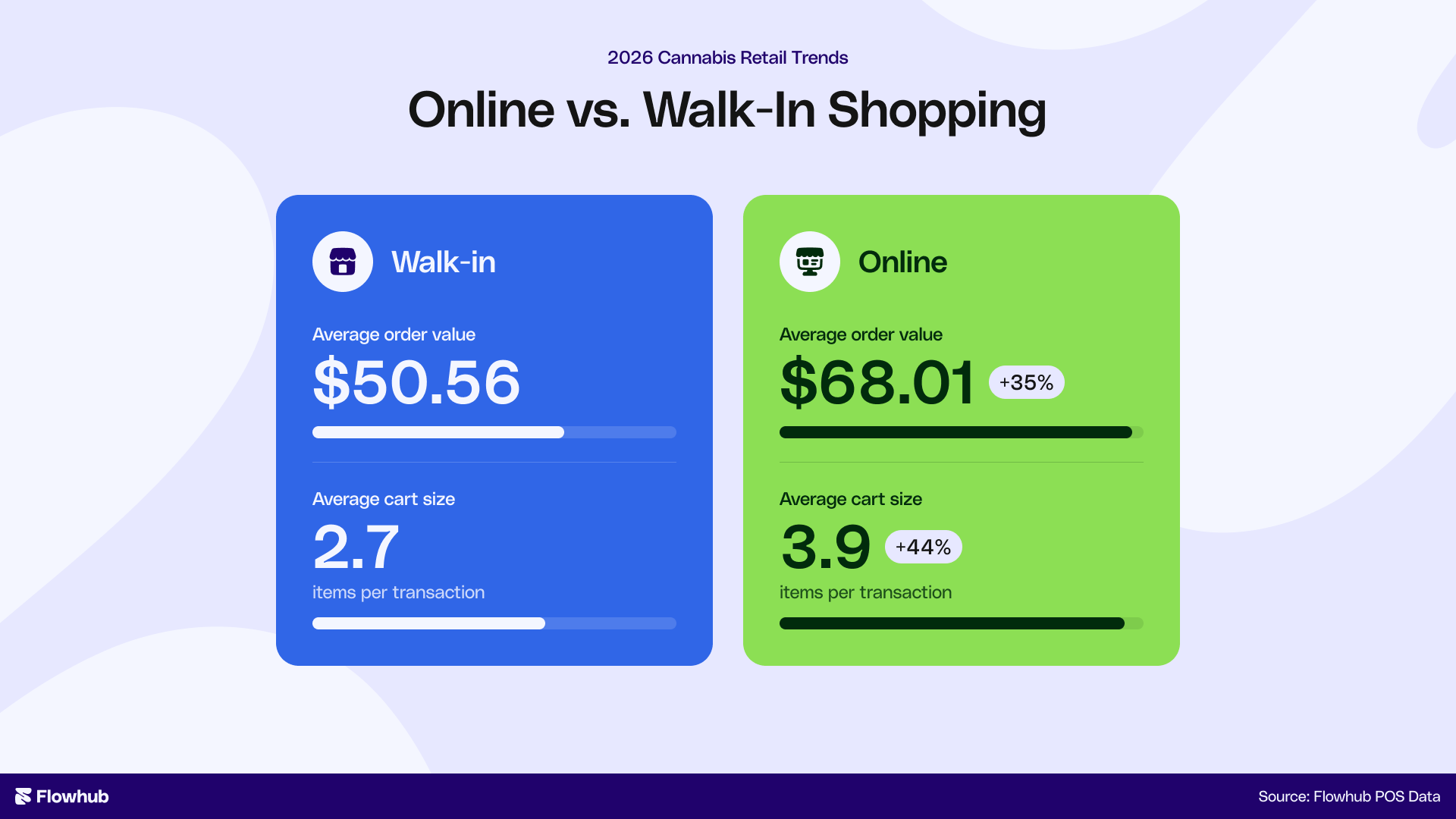
On average, online customers buy more items, and spend significantly more than traditional walk-in customers.
- Higher order value: Online orders carry an Average Order Value (AOV) of $68.01, which is roughly 35% higher than the $50.56 seen in walk-in transactions.
- Expanded Baskets: Digital carts are consistently 44% larger than physical ones, averaging 3.9 items compared to the 2.7 items found in walk-in baskets.
- Intentional Browsing: This "browsing premium" suggests that when customers shop online, they build carts with higher intent, likely due to the ability to review product details and total costs without the pressure of a physical line.
For retailers, the strategic implication is clear: Online isn't just a convenience, it is a revenue multiplier.
The biggest opportunity lies in offering online ordering to your dispensary customers. This might seem simple, but many dispensaries either haven’t implemented Ecommerce, or haven’t adequately marketed or implemented the digital processes into their workflows.
The shrinking basket phenomenon
A significant headwind plaguing the industry right now is basket compression. This could be related to the broader challenge of price compression, but is likely also impacted by macroeconomic challenges. Across the board, consumers are being cautious with where they spend.
In the cannabis industry, this is manifesting as a behavioral shift, not as a drop in demand, but a move toward smaller transactions amid price sensitivity. Shoppers are making quicker, less expensive visits rather than stocking up for the longer term.
- Average cart sizes have declined from 2.9 to 2.7 items over the last 24 months, a ~7% erosion.
- While basket sizes are shrinking, Average Item Value (AIV) has remained stable at $18–$20. The revenue squeeze is driven by quantity per visit, not a collapse in retail product pricing.
- Interestingly, basket sizes reached a high of 3.2 items in July 2024 before trending downward as price sensitivity took hold.
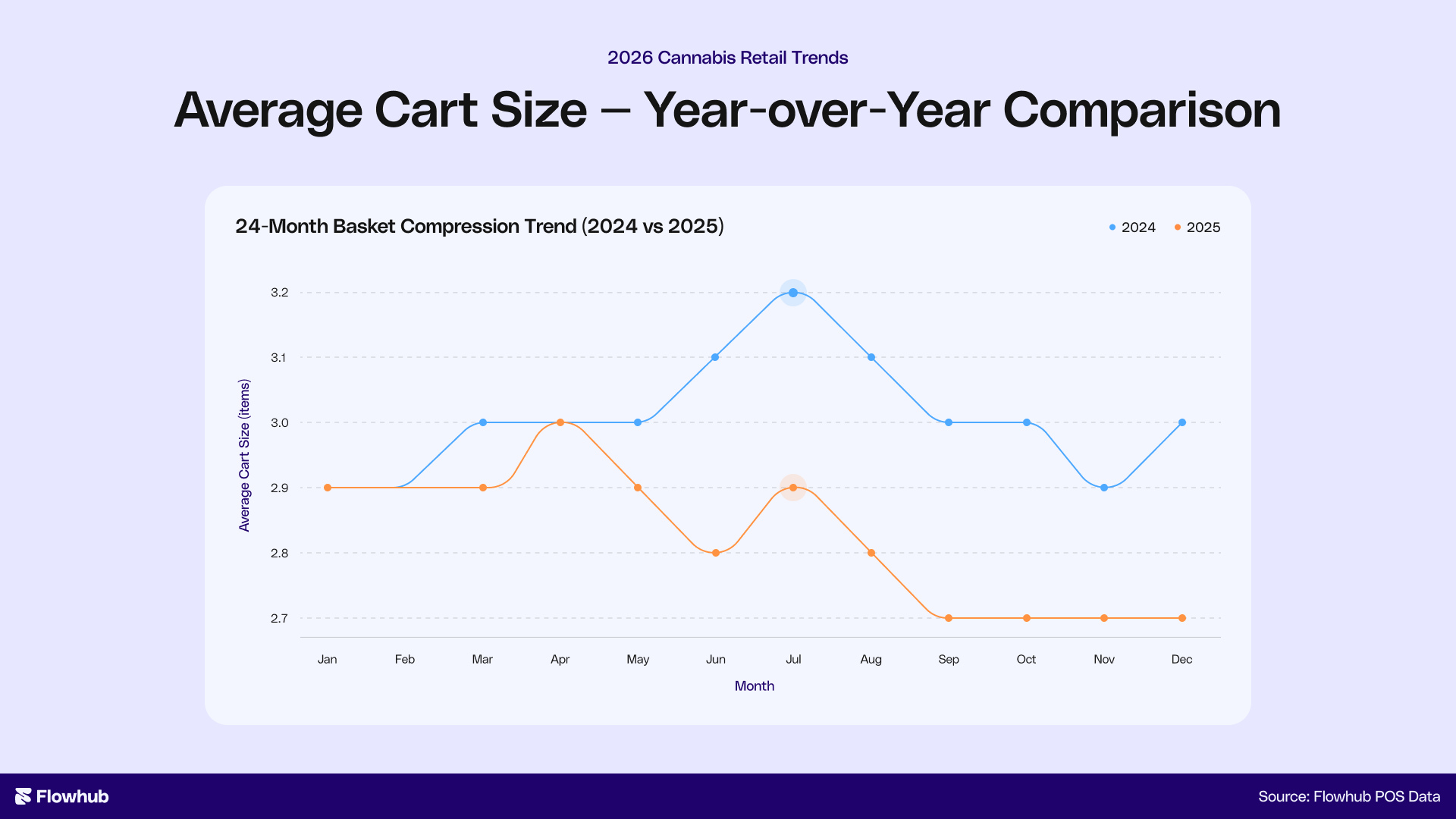
For retailers, the goal is to protect cart sizes by offering bundles, and offering strategic upsell opportunities. Train your budtenders on effective upsell techniques and think about your discounting strategy as a way to increase items, not just decrease the cost of existing items in the cart.
And don’t forget that the average online order basket includes 3.9 items. Another way to protect your cart sizes—and overall revenue—is to encourage more online orders.
Changing dispensary customer demographics
Success in 2026 requires moving beyond broad demographics to understand specific behavioral archetypes. Here are a few demographics currently making an impact for retailers:
Millennial dominance
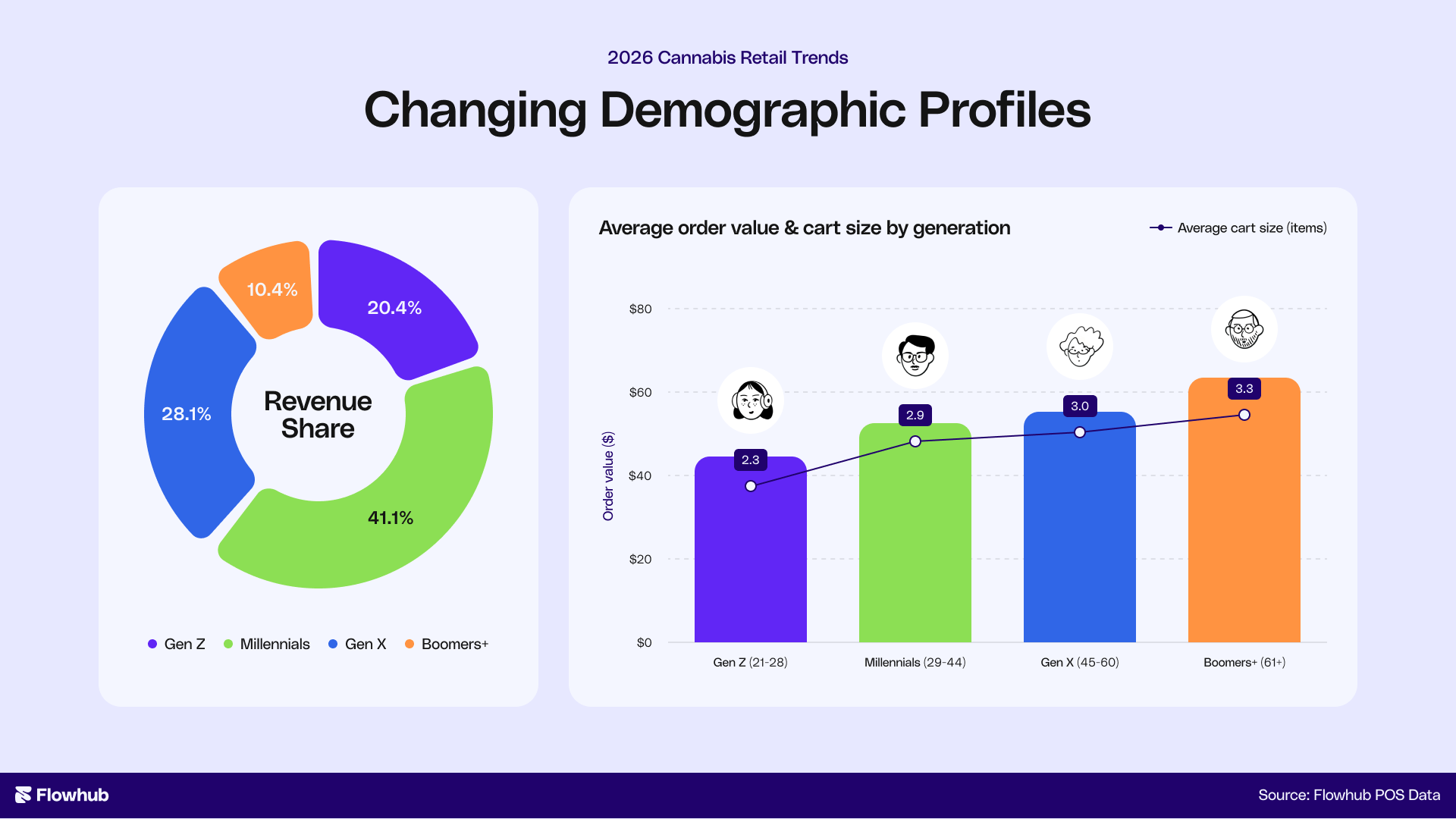
Millennials remain the primary economic driver of the industry, contributing 41% of total revenue with a steady AOV of $52.68 and cart size of 2.9.
In comparison, AOV and cart size are only slightly higher for Gen X, who account for 28% of revenue. Boomers only account for about 10%, but have much larger carts (at 3.3 items) and the highest AOV by far, at over $62.
The female opportunity
While representing only 32% of total revenue, this segment has been growing over time. Today, female shoppers are statistically more efficient than their male counterparts in two ways:
- Higher spend: Women have a higher AOV ($54.37) compared to men ($53.29).
- Larger baskets: Female shoppers average 3.0 items per visit, outperforming the 2.7 items seen with male shoppers.
Gen Z selectivity
Gen Z make up the third largest group, driving 24% of transactions, but they only account for 20% of total revenue. This is because they possess the lowest AOV ($44.95) and the smallest cart sizes (2.3 items).
This group is shopping more frequently, but spending less per trip. They often favor unique products or single-item purchases over broad discovery.
While these are general trends, what really matters for retailers is what is happening inside their individual stores. Location, aesthetics, product offering, and pricing will all have an impact on what type of customer you attract (and who you detract).
The key is to understand your unique customer base, then work to continue satisfying them, while also appealing to others. If you currently aren’t seeing many millennials or women, perhaps you need to make other changes to attract these segments.
The evolution of cannabis payments
Let’s get one thing straight: cash is still king in cannabis. But it’s losing ground. We know from retail trends across industries that consumers today prefer to pay with cards. But dispensaries don’t have the luxury of offering card payments like other industries. Cash is still king, not because of preference, but because of availability and reliability, making it more of a default fallback.
After a few years of infiltration of approved debit payment solutions for retailers, we’re seeing more options available and more adoption from shoppers. In 2025, payment methods became a direct predictor of basket size. Cash is no longer just a utility; it’s a spending cap.
- Cash's share of gross receipts dropped from 65% to 59% in a single year.
- Cash customers are limited by the physical bills in their pockets, contributing to a 7% decline in their AOV.
- Integrated digital payments (ACH and Apps) represent the highest-value tier, boasting a massive $93.50 AOV.
- Debit remains the primary beneficiary of the move away from cash, with gross receipts growing 8% year-over-year.
Offering digital payments isn’t just beneficial to customer satisfaction and retention, but has a meaningful impact on AOV and cart sizes. Just like with Ecommerce capabilities, the key is to find reputable payment providers and develop a strategic plan to onboard customers.
Read Next!
5 Tips to Help Customers Adopt Cashless Payments at Your Dispensary
Flower still accounts for nearly half of all cannabis purchases
Despite shifting consumer habits, product preferences remain remarkably stable. Flower still takes the top spot, but there’s more of a widening of the gap as consumers prefer more convenient consumption methods like vapes, edibles, and beverages.
- Category mix: Flower continues to be the industry cornerstone, accounting for nearly half of dispensary revenue.
- Flower (45%)
- Vapes (26%)
- Concentrates (17%)
- Edibles (11%)
- The pre-roll pivot: On 4/20 2025, pre-rolls overtook flower for the first time as the most in-demand product category, indicating a massive spike in consumer preference for convenience during high-traffic events.
Retailers need to consider not just the overarching category trends, but also the trends of their specific customer base. Women tend to like edibles more, and older generations lean away from smoking.
The key is to offer enough variety in your SKUs to satisfy all types of needs, without stocking anything that doesn’t sell. And it’s not just product categories; stock a variety of THC percentages, CBD options, low-dose products, and novelty items like infused pre-rolls.
Strategic recommendations for 2026
Now that you understand the trends impacting cannabis retailers this year, let’s talk about specific actions you can take:
- Check your tech. If you don’t have online ordering, with clean, user-friendly online menus reflecting real-time inventory, start here. Then, make sure you’re promoting online orders to current customers, even offering incentives, like a discount on your first online order, to encourage people to place their orders online.
- Incentivize multi-item baskets. Use "Buy 3, Save X" bundles or curated collections to combat the 2.7-item basket floor.
- Rethink your marketing segments. Cannabis consumer demographics have been changing for years, and the typical customer may not look exactly as you envision. Use your POS data to determine exactly who your customers are in order to better serve them. Then, figure out who you’re missing and how to engage them into your brand.
- Reduce payment friction. Prioritize the integration of debit and ACH payments to remove the spending ceiling inherent to cash. But just because you implement a payment solution doesn’t mean it’ll solve all your challenges. Shoppers may be skeptical so you’ll need to thoughtfully engage and onboard them.
- Start with your loyal customers. Loyalty members are a great place to start with new features and tools in your dispensary stack. Actively move loyalty members toward online ordering to capture the higher AOV associated with digital carts. And offer them further incentives to be “early adopters” in exchange for feedback.
- Optimize your product catalog. Retailers have to be efficient and only stock items that move. But you also need to carry a wide variety of items. You’ll need to find that sweet spot of having a great selection, without needing to impact your margins through discounting (or worse yet, wasting). Use your POS data to make educated purchasing decisions and strategic deals and promos to move items before you lose money on them.
For help with Ecommerce, payments, loyalty programs, and inventory management, check out Flowhub, built specifically for cannabis retailers.


