The President has signed an executive order directing federal agencies to move cannabis from Schedule I to Schedule III.
By moving forward with the plan, Trump is completing a process initiated under the Biden administration. That involved a scientific review by the U.S. Department of Health and Human Services (HHS) as well as the Drug Enforcement Administration (DEA) which concluded that Schedule III is a more appropriate classification for marijuana (cannabis)..
This is the most significant federal shift in cannabis policy in decades.
It is not full federal legalization.
It is not descheduling.
But it is a real step forward, and it has meaningful implications for cannabis operators, patients, and the broader industry.
What does “Schedule I” vs. “Schedule III” mean?
Under the Controlled Substances Act (CSA), drugs are placed into schedules based on three criteria:
- whether they have accepted medical use,
- their potential for abuse,
- and whether they can be used safely under medical supervision.
Schedule I is the most restrictive category. Substances in Schedule I are defined as having no accepted medical use and a high potential for abuse. For decades, cannabis has been placed in this category, alongside heroin.
Schedule III is different. Substances in Schedule III are recognized as having accepted medical use and a lower potential for abuse. Drugs like ketamine and certain codeine formulations are classified this way.
You can see the federal definitions and list of scheduled substances directly from the DEA here.
Moving cannabis to Schedule III means the federal government is formally acknowledging what patients, doctors, and state regulators have long known. Cannabis has medical value.
That alone is historic.
What changes with Schedule III?
Cannabis is recognized as medicine at the federal level
This is the first time the federal government has openly recognized cannabis as having accepted medical use since the CSA was enacted in 1970. That brings federal policy closer to the reality on the ground, where most states operate medical cannabis programs and millions of patients use cannabis legally.
This change reduces stigma and creates a more honest foundation for future federal policy.
280E relief is the most significant potential impact
For operators, the most consequential impact of moving cannabis to Schedule III is relief from Section 280E of the federal tax code.
Section 280E prevents businesses that sell Schedule I or II substances from deducting ordinary business expenses like rent, payroll, and marketing. Because cannabis has remained in Schedule I, state-legal operators have been subject to this punitive tax treatment for years.
Once cannabis is formally reclassified to Schedule III, 280E would no longer apply to state-legal cannabis businesses. That would allow operators to claim standard federal deductions, materially improving cash flow and profitability.
The impact could be substantial. Industry analysis according to Headset suggests the typical dispensary could save approximately $268,000 per year in federal taxes, with higher-volume stores seeing annual relief closer to $800,000 per location. At the industry level, removing 280E could unlock $1.6 to $2.2 billion in incremental after-tax cash flow annually.
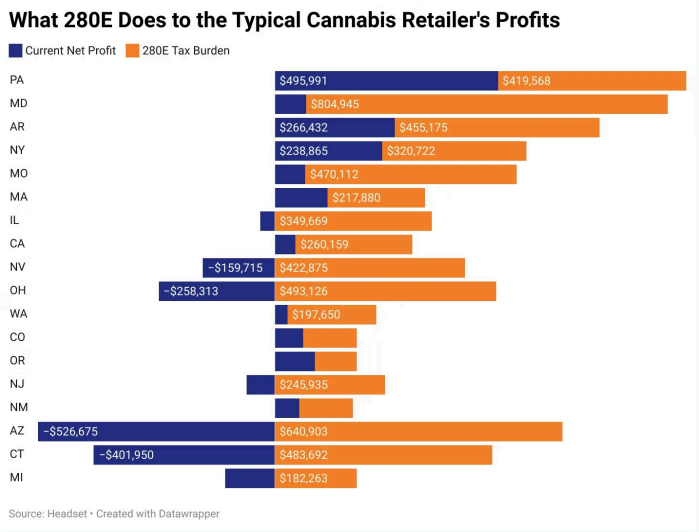
This level of relief would give operators real breathing room. More businesses could stabilize, reinvest in hiring and technology, and reduce the risk of insolvency after years of operating under extreme financial pressure.
Cannabis research expands
Schedule I status has also made cannabis research unnecessarily difficult. Researchers have faced additional approvals, limited access to materials, and fewer funding opportunities.
Schedule III lowers those barriers. It allows more research into safety, dosing, and medical applications, without forcing cannabis into a pharmaceutical-only pathway.
The FDA outlines the current research framework here.
Over time, more research means better data, safer products, more innovation, and stronger credibility for cannabis as medicine.
What does NOT change with Schedule III?
This part matters just as much as what changes.
Rescheduling does not legalize cannabis at the federal level. Cannabis remains federally controlled under the Controlled Substances Act.
It does not override state cannabis programs. States will continue to license and regulate cannabis businesses as they do today.
It does not create automatic interstate commerce.
It does not immediately expunge federal cannabis records.
It does not instantly fix banking access.
Banking reform still requires congressional action, such as the SAFER Banking Act.
Despite a lot of concern online, rescheduling does not turn cannabis over to Big Pharma.
Federal scheduling affects taxation, research, and criminal law. It does not force state-regulated cannabis products into the FDA drug approval process. That pathway only applies when a company chooses to develop a product as a prescription drug.
Read next
Cannabis Schedule III and the Myth of a Big Pharma Takeover
A regulated market is safer than an unregulated one. Licensed dispensaries check IDs. Street dealers do not.
What happens next?
The executive order does not instantly rewrite federal law. It directs agencies to complete the formal process required under the Controlled Substances Act.
That process includes:
-
formal rulemaking by the Department of Justice (DOJ) and Drug Enforcement Administration (DEA)
publication and implementation of final rules
This will take time. Implementation details will matter. Operators should work with accountants and advisors to understand how and when 280E relief applies to their specific situation.
At Flowhub, we’ve spent years advocating for responsible federal reform through groups like the U.S. Cannabis Roundtable (USCR), including work demonstrating that regulated cannabis businesses can operate safely and compliantly at scale. That groundwork helped make this moment possible.
Progress, not the finish line
Rescheduling cannabis to Schedule III is not the end goal. Full descheduling and comprehensive federal reform are still needed.
But this is real progress.
It removes an unfair tax burden.
It reduces stigma.
It opens the door to research, legitimacy, and long-term stability.
Incremental change is how federal reform actually happens. This moment matters because it moves cannabis policy out of denial and closer to reality.
We will keep tracking what comes next and sharing what matters most for operators as the details become clear.
This is just the beginning.